



Most banks and financial services firms have tried AI by now. A team builds a fraud model, or an assistant that answers questions from policy documents. The pilot works well on a clean sample. Then it meets the real data, and progress slows down.
The reasons are usually the same. One customer shows up under different IDs in different systems. Teams use the same word to mean different things. Nobody can say exactly where a model input came from, which becomes a problem the moment a regulator or the model risk team asks.
AI-ready data is data a model or an assistant can use without someone fixing it by hand first. Once a firm has it, each new AI idea gets to production faster, because the groundwork is already done. This article covers what that groundwork looks like in financial services and where to start.
What AI-ready data looks like
There is no single tool that makes data AI-ready. It comes down to a short set of questions you can ask of any dataset before a model uses it.
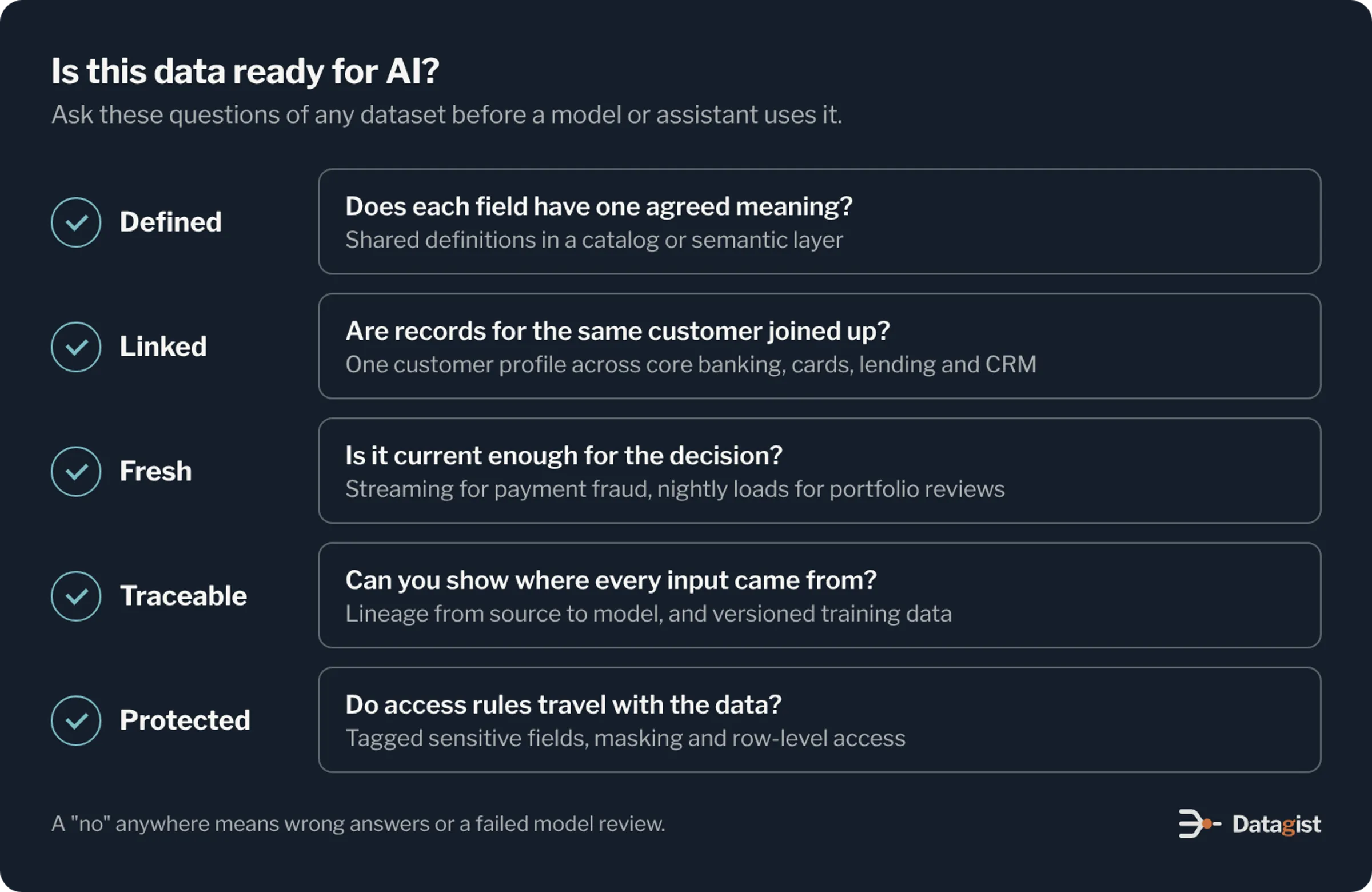
If the answer to any of these is no, the model will either give wrong answers or fail its review. The sections below go through each question.
Give every key term one meaning
Ask risk, finance and marketing what counts as an active customer and the answers often differ. Risk may count anyone with an open account. Marketing may count anyone who logged in this quarter. A churn model trained on one definition and reported on another will confuse everyone who reads the results.
Write the definitions down once, in a data catalog or a semantic layer, and point models, dashboards and reports at the same definitions. Databricks and Snowflake both let you keep these definitions and tags next to the tables, so they stay in step when the tables change. We wrote more about this in define the metric once.
Know who your customer is
KYC checks, anti-money laundering and credit decisions all depend on knowing that the person in the card system is the same person in the mortgage system and the CRM. When those records are not linked, a risk model sees several small customers where there is really one large one.
Master data management fixes this. A platform like Reltio or Informatica matches and merges records from each system into one profile, and keeps the links between people, businesses and the accounts they hold. In business banking the hierarchy matters as well: which companies sit under which parent, and who the beneficial owners are. Feed your models from that master profile and their risk scores reflect the whole relationship. Before you configure the platform, prove your match rules on real data.
Match data freshness to the decision
A fraud check at the moment of payment needs transaction events within seconds. A monthly review of the credit portfolio is fine with a nightly load. Decide how fresh each use case needs its data to be, then build the pipeline for that.
Streaming everything is expensive and hard to run. Loading everything in batches means a fraud model sees a transaction after the money has left. Most firms end up with both, and the use case decides which one a dataset gets.
Be able to explain every input
Regulators and internal model risk teams expect you to show how a model reached a decision. For a declined loan or a flagged transaction, that means knowing which data went in, where it came from and what happened to it on the way.
Capture lineage from the source system through each transformation to the feature the model uses. Keep a versioned copy of the training data, so you can rebuild the exact model that made a past decision. Run data quality checks inside the pipeline and stop the load when one fails, so a bad file never reaches a model.
Protect sensitive data before a model sees it
Account numbers, tax IDs and transaction details should never end up in a training set or a prompt by accident. Tag sensitive columns when the data lands, then apply masking and row-level access from those tags. A model built for one business line should only see that business line’s data.
Generative AI adds another layer. An assistant that answers from internal documents has to respect who is allowed to read each document. We explain how in building an AI assistant that respects document permissions.
Start with one use case
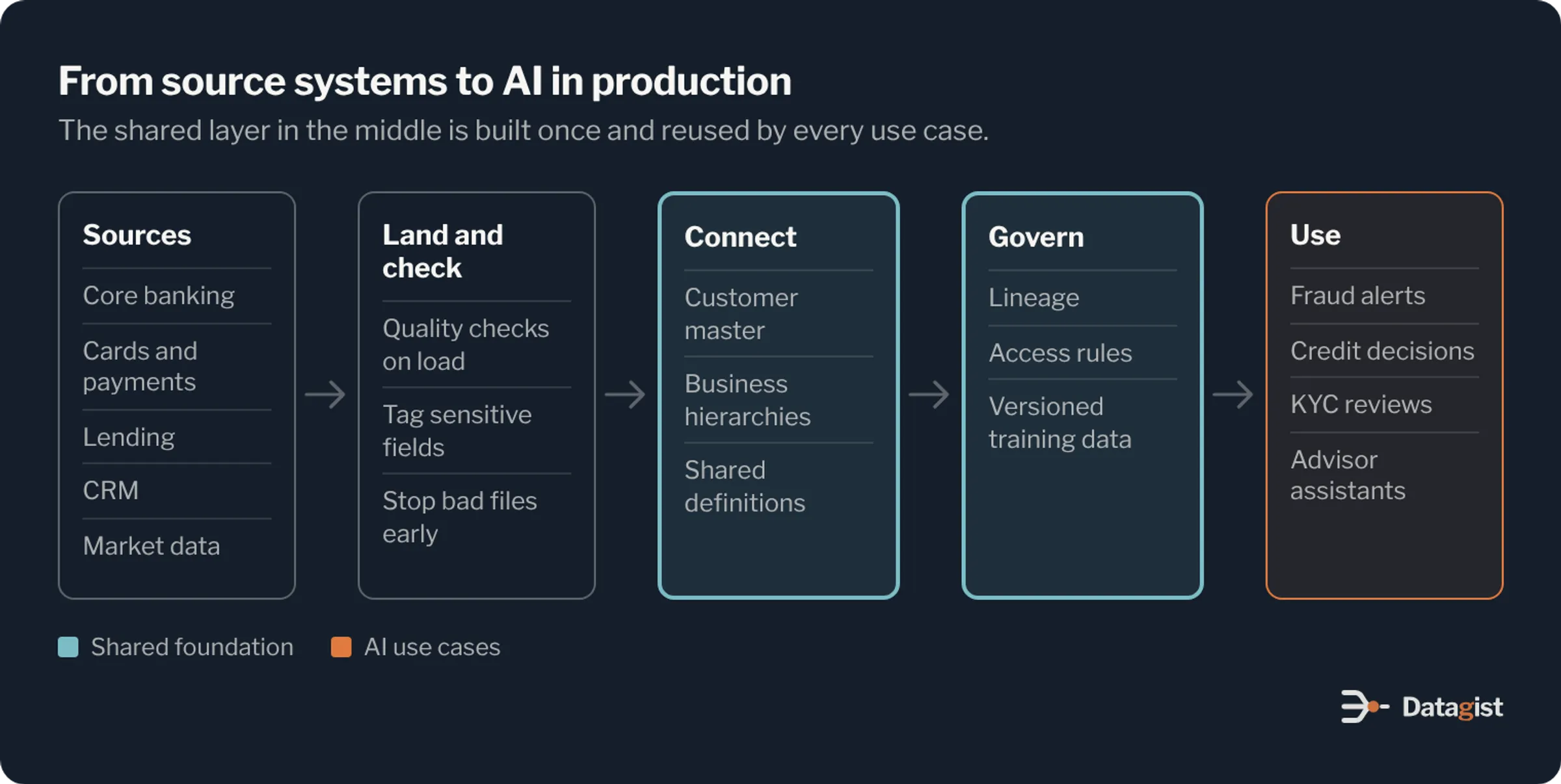
Trying to make all of your data AI-ready before building anything takes years and rarely finishes. Start from a use case the business cares about instead, such as faster KYC refreshes or fewer false fraud alerts. List the data it needs and check that data against the questions above. Fix what blocks the use case and leave the rest for later.
Before you commit budget, look at the real data. A short check of the data shows whether the use case is realistic and what needs fixing first.
Reuse the work for the next use case
This is where the speed comes from. The customer master, definitions, lineage and access rules you built for the first use case are still there for the second. A credit model can use the same customer profile the fraud team built. An advisor assistant can use the same access rules.
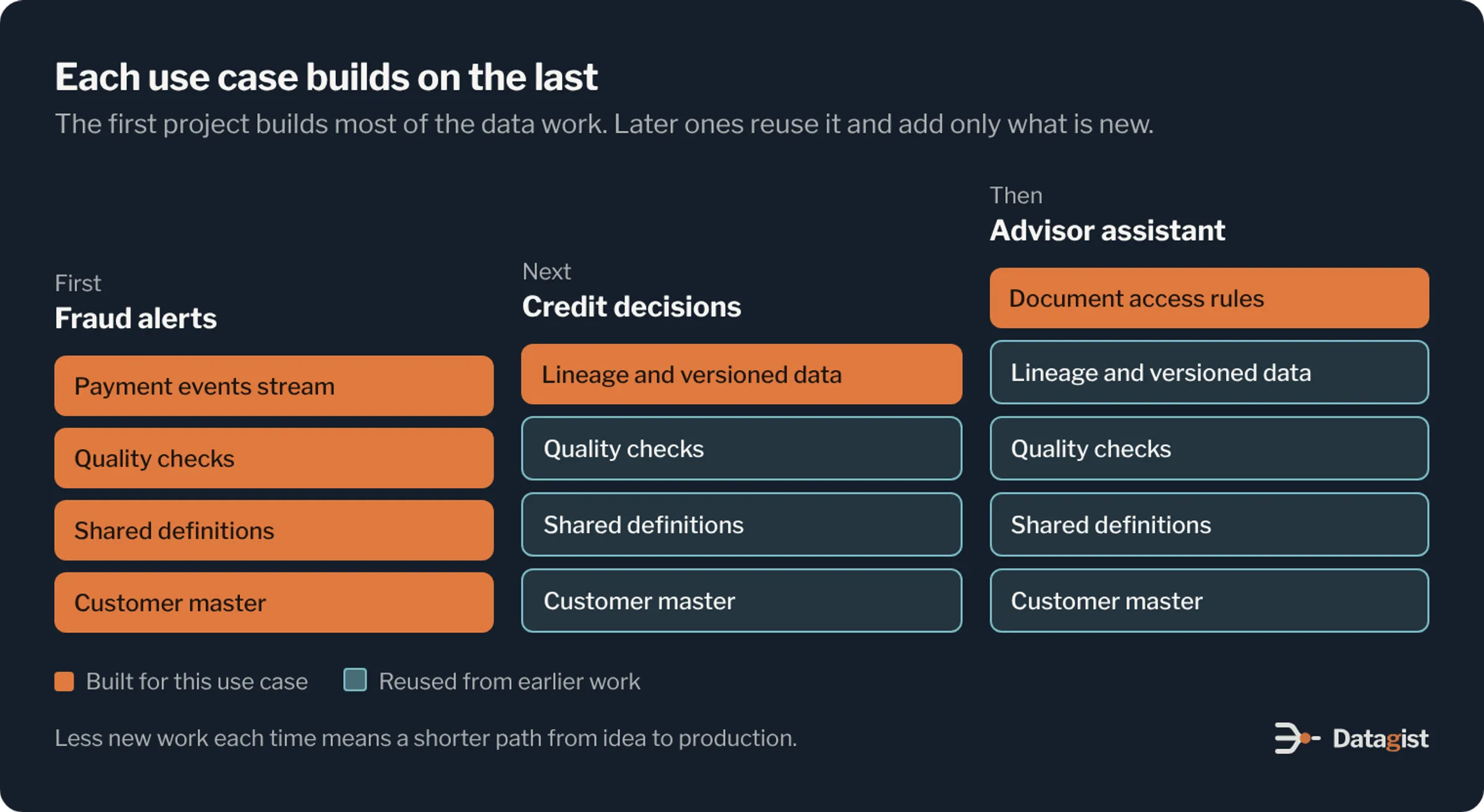
Treat these pieces as shared products with an owner, and add to them each time. After a few use cases, a new AI idea starts with most of its data already in good shape, and the time from idea to production keeps getting shorter.
We help banks and financial services firms get their data ready for AI, from the customer master to the governed platform underneath. If one of your AI projects is stuck on the data, tell us about it and we will suggest where to start.