



Most large companies now have AI agent pilots. A service team has an agent that drafts replies. Finance has one that matches invoices. IT has one that resets access. Each demo went well. A year later, few of them handle real volume, and the ones that do run on their own stack with their own copy of the data.
The model is rarely what separates a promising pilot from an agentic enterprise. Today’s models can reason through a multi-step task and call business systems well enough for a lot of work. What holds companies back is everything around the model: data the agent can trust, permissions it can act within, a way to prove it works, and someone in the business who owns the result.
This article covers how to close that gap. It is written for the people who have to make agents work at scale: CIOs, chief data officers, enterprise architects and the business leaders who will own the outcomes.
Why pilots stall
Pilots are built to show what is possible. They use a clean sample of data, a friendly group of users and a narrow task. Production is different. The data is messy and spread across systems. Users ask things nobody planned for. The agent needs to update a record, and someone has to decide whether it is allowed to.
We see the same reasons come up again and again. The data the agent needs is locked in systems it can’t reach, or it reaches a copy that is out of date. Security and risk teams are brought in at the end and can’t approve an agent they can’t inspect. Nobody measured how the work performed before the pilot, so nobody can prove the agent improved it. And each pilot was built by a different team with different tools, so the second agent costs as much as the first.
None of these are model problems. They are data, platform and operating problems, and they are the work that turns experiments into impact.
The leaps from pilot to enterprise
Moving to enterprise scale takes a handful of deliberate shifts. Each one changes how agents are chosen, built, governed or measured.
| From | To |
|---|---|
| Demos that answer questions | Agents that finish a step in a real workflow |
| Each team builds its own stack | A shared platform with approved models, tools and data |
| Data copied into each pilot | Governed context the agent reads at run time, with the user's permissions |
| Judged by how good the answers look | Judged by cycle time, error rate and cost per case |
| Security review at the end | Identity, limits and logging built in from day one |
| An IT project | A product with a business owner, a backlog and a support model |
Companies that make these shifts early find that the third and fourth agents come much faster than the first. Companies that skip them end up with a collection of impressive demos and a growing support bill.
Pick work worth automating
Start from the workflow. The best early candidates share a few traits. The work is high in volume and follows rules most of the time, with some judgment at the edges. The data needed to do it already exists in your systems. The outcome is easy to measure. And mistakes can be caught and undone before they cause harm.
Invoice exceptions, customer service cases, supplier onboarding, access requests and sales order checks often fit. A one-off strategic decision usually doesn’t. Map the workflow step by step and mark which steps an agent could do, which need a person and which need a system change first. That map becomes the scope of the agent and the baseline you measure against.
Give each agent a business owner from the start. This is the person who answers for the outcome, decides what the agent may do and signs off on changes. Without one, agents drift back to being IT experiments.
Build a shared platform
The fastest way to scale is to stop building agents from scratch. Put the common parts into a shared platform that every team builds on, and let the business teams focus on their workflows.
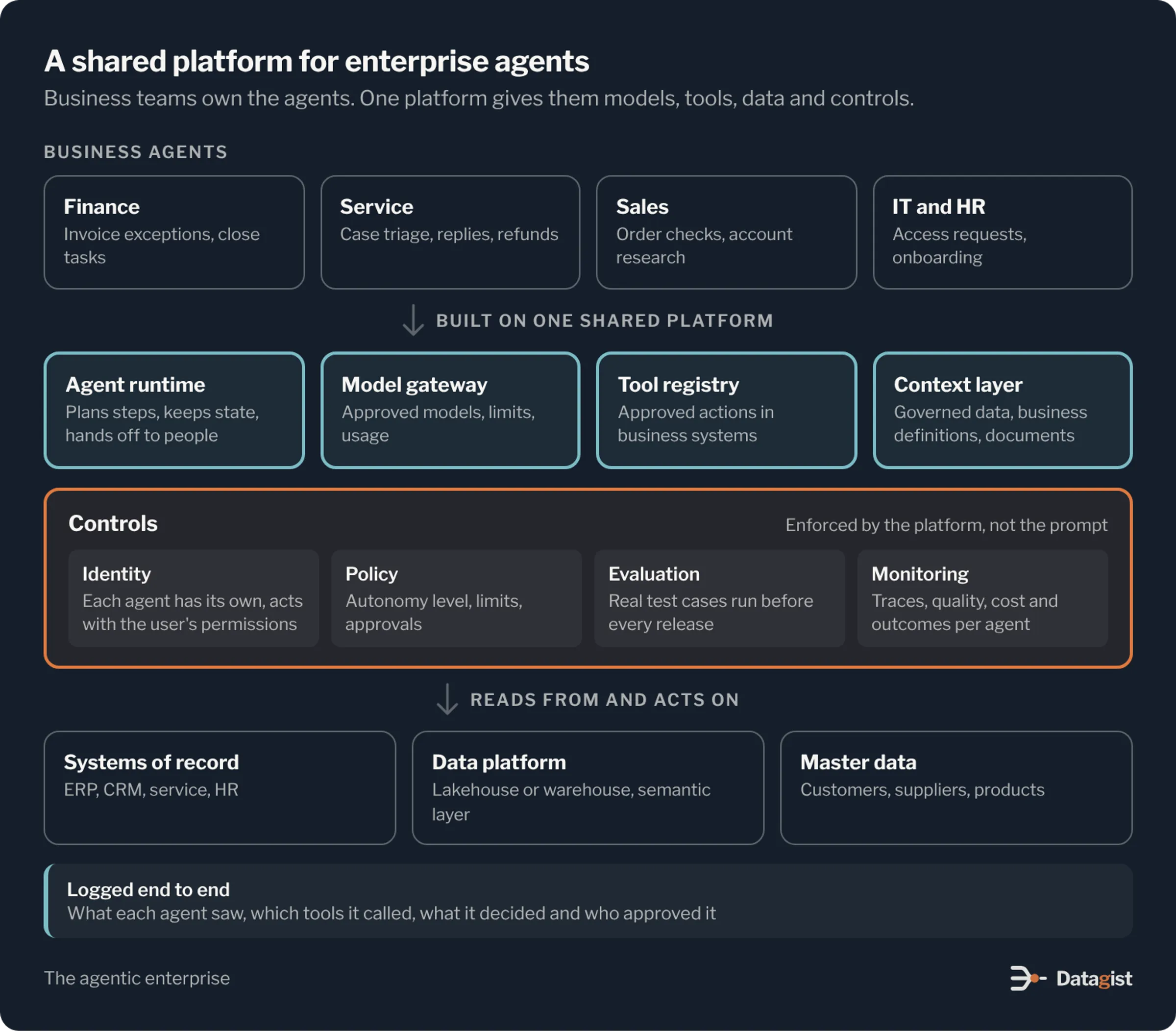
The agent runtime plans and runs the steps of a task, keeps state across long-running work and hands off to a person when needed. The model gateway routes each call to an approved model, applies limits and records usage. Teams can switch models without rewriting their agents.
The tool registry lists the actions agents are allowed to take in business systems, such as creating a case, posting a credit or updating a supplier. Each tool has a clear description, typed inputs and outputs, and an owner. The Model Context Protocol is becoming a common way to expose these tools, and most agent frameworks support it. The rule that matters is that tools call your existing services, so business logic stays in one place.
The context layer gives agents the information they need to reason well: governed data from your platform, shared business definitions and the documents that hold policy and procedure. This is where most of the hard work sits, and it deserves its own section.
Data is the real constraint
An agent is only as good as the context it gets. If it pulls a customer record with the wrong address, or a revenue number that finance defines differently, it will act on that error with full confidence and at machine speed.
Three things make the difference. First, a semantic layer that defines business terms once, so “active customer” or “net revenue” means the same thing to an agent as it does on the CFO’s dashboard. Second, mastered reference data for customers, suppliers and products, so the agent isn’t choosing between duplicates. Third, retrieval over documents that is current, tagged with its source and filtered by who is asking.
Access control has to follow the data all the way to the agent. When an agent works for a person, it should see only what that person is allowed to see. Enforce this in the data platform and in retrieval, using the person’s identity. Don’t rely on the prompt to keep the agent from showing restricted data, because a prompt is not a security control.
Guardrails people will trust
Business leaders don’t approve agents in the abstract. They approve a specific set of actions, with limits, for a specific workflow. Make that explicit by setting a level of autonomy for each action the agent can take.
| Level | What the agent does | Good fit |
|---|---|---|
| Assist | Finds and summarizes. A person decides and acts. | Research, case summaries, policy questions |
| Draft | Prepares the output. A person reviews and sends. | Customer replies, journal entries, contract redlines |
| Act with approval | Takes the action after a person approves it. | Refunds over a limit, vendor changes, access requests |
| Act and report | Takes the action within set limits and logs it for review. | Low-value refunds, ticket routing, data fixes with rollback |
Most agents start at assist or draft and earn more autonomy as the evidence builds. Write the limits down as policy the platform enforces, such as a refund ceiling or a list of vendors the agent may change. Keep them out of the prompt.
Give every agent its own identity, separate from the people it works for, so its actions are traceable and its access can be cut off without affecting anyone else. Log every step: what the agent saw, which tools it called, what it decided and who approved it. When an auditor or a customer asks why something happened, that record is the answer.
Test before every release. Build a set of real cases with known good outcomes, including the awkward ones, and run it every time the prompt, model, tools or data change. Hold the release if results drop.
Measure business outcomes
Answer quality matters, but it is not why the company invested. Measure the agent the way you would measure a team doing the same work, and compare against the baseline you took before launch.
| Measure | What it tells you |
|---|---|
| Cycle time per case | Whether the work is actually faster end to end |
| Share of cases finished without hand-off | How much of the workflow the agent really covers |
| Human override and correction rate | Where the agent is wrong or the rules are unclear |
| Error and rework rate after release | Whether quality holds up over time |
| Cost per case, including model and review time | Whether the agent pays for itself at volume |
| Adoption by the people it was built for | Whether the team trusts it enough to use it |
Report these to the business owner every month. When the numbers are good, they make the case for the next agent. When they are not, they show where to look: the data, the tools, the rules or the workflow itself.
The operating model
Technology gets an agent to production. The operating model keeps it there and makes the next one cheaper. A small central platform team owns the shared runtime, gateway, tool standards and controls. Business teams own their agents, their workflows and their results. A risk and security group runs a fast, repeatable review based on autonomy level, so low-risk agents don’t wait in the same queue as high-risk ones.
Bring the people who do the work into the design. They know where the exceptions are, and they are the ones who will decide whether to trust the agent. Plan for how their roles change. Time saved on routine cases should go to the harder cases, the customers who need a person and the improvements nobody had time for.
Where to start
Pick one workflow with a committed business owner, clear volume and data you already hold. Measure how it performs today. Build the agent on the platform pieces you will reuse, even if they start small: a model gateway, a tool registry with a few approved tools, governed access to the data it needs, logging and an evaluation set.
Launch at assist or draft level, measure against the baseline and raise autonomy where the evidence supports it. Then take the second workflow onto the same platform and watch how much faster it goes. That speed is the real sign that you have moved from experimentation to an agentic enterprise.
We help companies build the data foundations, platforms and controls that let AI agents run in production. See our GenAI & Agents work, or talk to us about the workflows you want to take from pilot to scale.
Get new insights by email.
One email when we publish a new post.
You're subscribed.
We sent a welcome email to . Didn't mean to sign up? Reply to it and we'll unsubscribe you.